
Deepgram's Acquisition of Daily: Voice AI Is Moving From Speech Technology to Business Automation
Deepgram's acquisition of Daily and Pipecat is more than another consolidation deal. It reflects an expanding market in which infrastructure providers are moving toward complete voice AI platforms, while the next competitive advantage is increasingly defined by business execution and measurable ROI.
Contents
Deepgram just announced the acquisition of Daily, the company behind Pipecat. On the surface, it's another infrastructure acquisition in an increasingly competitive voice AI market.
I think the more interesting question is why Deepgram needs Pipecat at all.
For years, speech recognition and synthesis were valuable standalone technologies. Now, one of the strongest players in that market is investing in orchestration, real-time communications infrastructure, agent hosting, specialized language models, and even vertical applications.
Deepgram has come a long way from its original speech recognition business. In January 2026, it raised $130 million at a $1.3 billion valuation and acquired OfOne, a company building voice AI for restaurant drive-throughs. On October 29, it announced the acquisition of Daily, adding WebRTC infrastructure, an established orchestration ecosystem, and managed agent deployment capabilities. The transaction value was not disclosed.
This is not simply an attempt to capture a larger share of existing speech API spending. It is a bet on what the voice AI market is becoming.
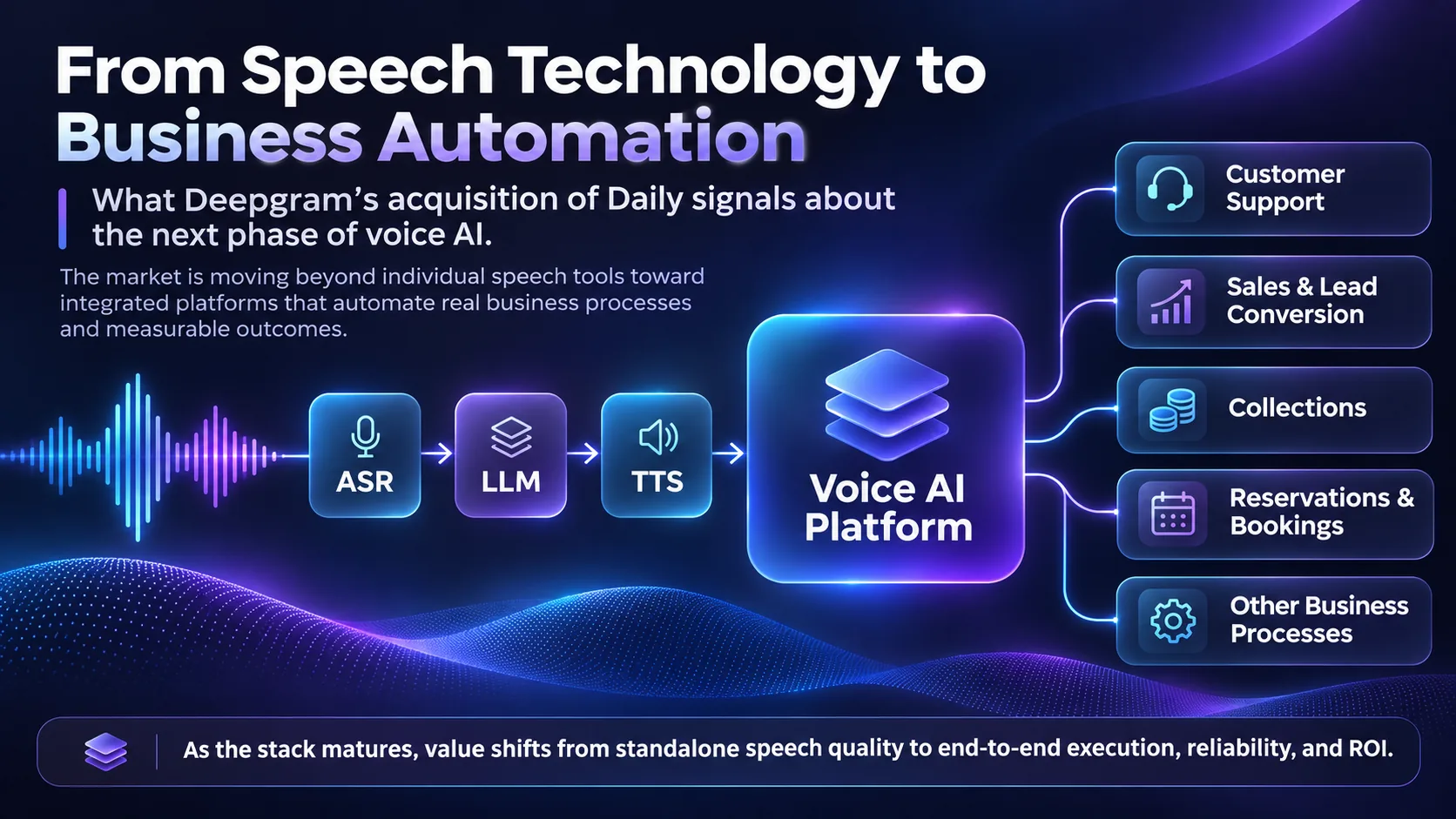
The industry is moving beyond individual speech technologies toward integrated systems capable of automating business processes. As infrastructure becomes more capable and accessible, the range of economically viable applications expands.
That creates an interesting contradiction: building a basic voice agent is getting easier, while building one that reliably replaces a meaningful business process remains difficult.
I believe this distinction will shape both market growth and competition over the next several years.
1. The growth is real, but funding is not the best evidence
Voice AI has attracted substantial investment over the past two years. Deepgram's $130 million round was followed closely by LiveKit's $100 million Series C, valuing the real-time communications and agent infrastructure company at $1 billion.
These investments reflect strong expectations about future demand. They do not, by themselves, establish that the market is delivering.
For that, I prefer looking at revenue, production traffic, and adoption.
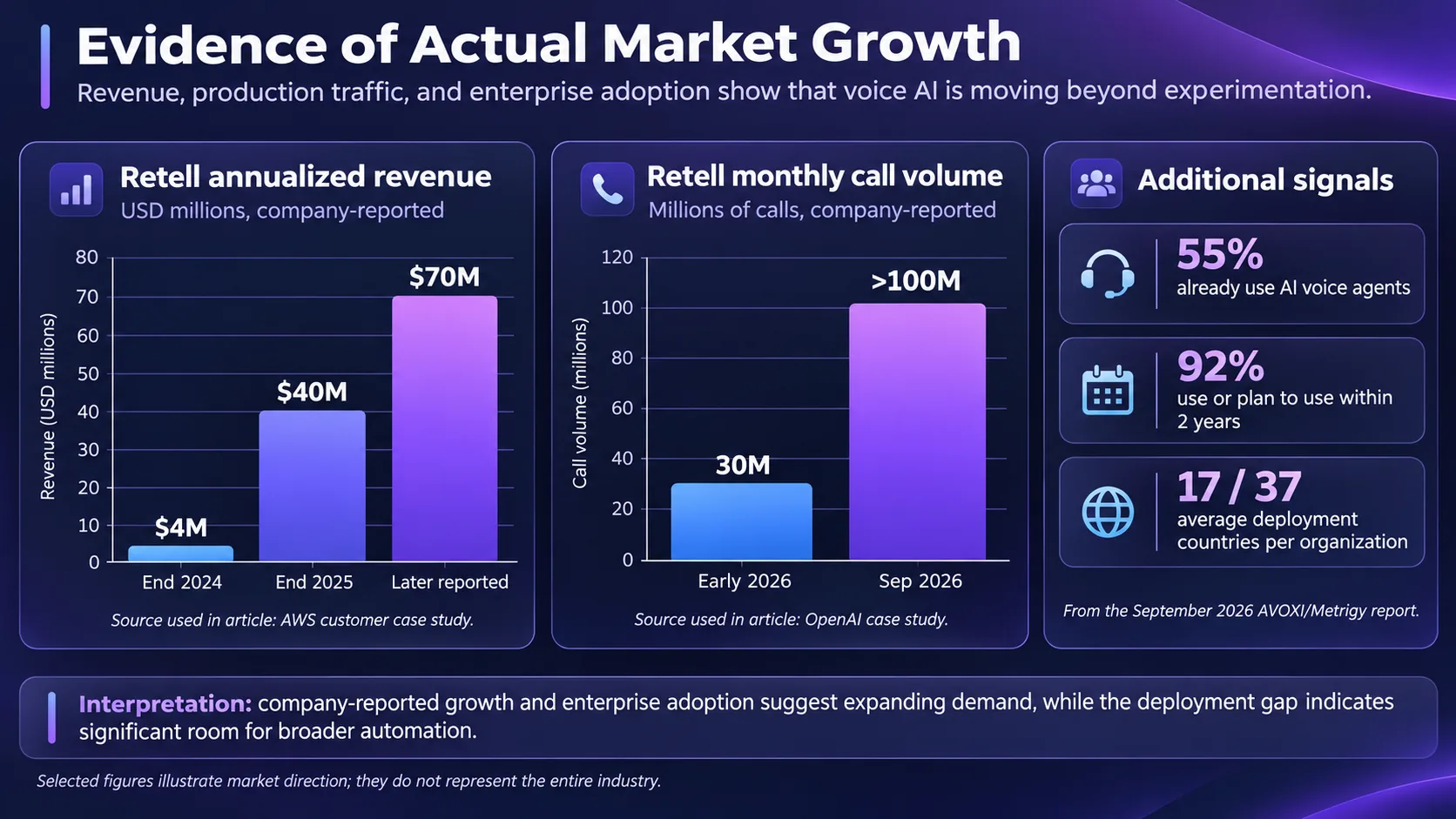
Retell AI provides one useful example. According to an AWS customer case study, the company increased its annualized revenue from approximately $4 million at the end of 2024 to $40 million at the end of 2025, subsequently reaching around $70 million.
In October 2026, a separate OpenAI case study reported that Retell's monthly call volume had increased from 30 million in early 2026 to more than 100 million by September.
Another infrastructure provider, Vapi, was handling more than three million calls per day by October 2026, according to an Axiom engineering case study.
These are company-reported figures rather than independently audited industry statistics. They also represent selected fast-growing providers, not the entire market. But actual call volumes are a more substantial indicator of adoption than another headline valuation.
Enterprise surveys point in a similar direction.
The September 2026 AVOXI/Metrigy State of International Voice report, based on 200 IT and customer experience decision-makers, found that 55% of surveyed organizations already used AI voice agents, while 92% were using or planning to use them within two years.
More interestingly, organizations operating across an average of 37 countries had deployed voice AI in only 17.
The survey is not representative of every enterprise, and reported adoption tells us little about the volume or complexity of automated interactions. Nevertheless, that deployment gap illustrates something important.
Initial adoption and comprehensive business automation are very different stages of market development.
Many organizations may have already experimented with voice agents, but extending automation across business units, geographies, languages, and processes introduces another level of complexity.
And there is a second growth mechanism.
As inference becomes more efficient and integrated platforms reduce implementation overhead, the economics of additional use cases can improve. Processes that previously required expensive custom development or were too complex to automate may become commercially viable.
This expands the addressable market beyond replacing existing IVR systems or handling simple customer inquiries.
The result is potentially a reinforcing cycle: better infrastructure enables more applications, growing application demand justifies further infrastructure investment, and increasing scale supports further improvements.
That is the broader context in which I would interpret Deepgram's acquisition.
2. Deepgram is moving up the stack — and the stack itself is changing
The original voice AI value chain was relatively straightforward. Speech recognition converted audio into text, a language model generated a response, and speech synthesis turned that response into audio.
The components were technically challenging, and high-quality speech recognition or synthesis could provide substantial commercial differentiation.
But an enterprise voice agent is much more than these three models connected together.
It needs transport infrastructure, turn-taking, interruption handling, conversation state, orchestration, retrieval, tools, business-system integrations, guardrails, observability, and reliable deployment. And typical 5 or 10% WER of ASR in best-available models must not ruin the turn or a whole conversation and not lead to irreversible consequences.
And these components need to work together under real-time constraints.
A transcription model can be extremely accurate while the overall agent still interrupts the customer. A language model can generate an excellent response while the system confirms an operation that has not actually completed. A TTS model can begin speaking within milliseconds while the agent takes several seconds to provide useful information.
Optimizing components does not automatically optimize the system.
Deepgram's acquisition addresses this integration problem directly.
Daily contributes the real-time communications layer, including WebRTC and global media infrastructure. Pipecat provides orchestration and a broad ecosystem of model integrations. Pipecat Cloud adds managed hosting.
Combined with Deepgram's speech models, the company can now offer more of the infrastructure required to develop and operate complete voice agents and strengthens positioning of company in the competition with ElevenLabs and their already-launched Agents.
Its October announcements also included Think-Live, a model designed to manage conversational behavior while another model handles the underlying task, and Think-Fast, a specialized instruction-following model supporting tool execution.
Deepgram is effectively moving from individual speech technologies toward a larger runtime and execution platform.
This is consistent with another architectural development we have been following in GPT-Live and Gemini Live: separating latency-sensitive conversational interaction from slower reasoning and external operations.
Different vendors approach that separation differently, and the architectures are not equivalent. But they are responding to a common problem: a useful voice agent must remain conversationally responsive while performing real work.
The practical challenge is not simply how quickly the system produces audio. It is how reliably it coordinates conversation, reasoning, external actions, and application state.
Three layers of the emerging market

I find it useful to distinguish three overlapping layers.
| Layer | Core capabilities | Primary source of value |
|---|---|---|
| AI and communications infrastructure | ASR, TTS, LLM inference, telephony, media transport | Model performance, latency, reliability, and unit cost |
| Voice agent platforms | Orchestration, session state, tools, deployment, guardrails, observability | Integration, developer productivity, and operational reliability |
| Business execution systems | Domain workflows, enterprise integrations, compliance, exception handling, outcome measurement | Completed business processes and measurable ROI |
These are functional categories, not necessarily separate classes of companies.
Deepgram's original business was concentrated in the first layer. Its acquisition of Daily strengthens its position in the second. Its earlier acquisition of OfOne demonstrates an interest in the third.
That last transaction is particularly revealing.
Restaurant drive-through automation is not just a different interface for speech recognition. It is a specific business process with operational requirements, integrations, failure modes, and measurable outcomes.
Deepgram's expansion suggests that infrastructure providers increasingly recognize value beyond model inference.
It also creates a competitive question for independent voice AI companies.
As platforms become more comprehensive, basic agent functionality becomes easier to obtain. A generic receptionist or FAQ agent may eventually be little more than a configuration of standard platform capabilities.
More complex enterprise workflows are different.
Automating a bank's customer service operation requires considerably more than natural conversation. Depending on the use case, the system needs authentication, customer-specific data, banking integrations, policy enforcement, transaction execution, escalation, and auditability.
The same applies to insurance claims, collections, healthcare intake, and enterprise sales.
This distinction is central to how we approach voice AI at AgentUnicorn.AI: the objective is not to provide a conversational interface in isolation, but to integrate the capabilities necessary to automate the underlying business process.
That includes components extending well beyond speech and orchestration.
The boundaries between the three layers will continue to shift. Infrastructure providers will expand into applications, while application providers will increasingly develop proprietary runtime and orchestration capabilities where that gives them better performance or control.
I don't expect one approach to win universally.
The more important competition will be over which companies can deliver the best end-to-end results for specific customers and workflows.
3. The Pipecat acquisition raises a legitimate open-source question
Pipecat is arguably the most strategically interesting part of the transaction.
Daily developed it as a vendor-neutral orchestration framework, allowing developers to combine different speech models, LLMs, transports, and execution components.
That independence is valuable in a market where the relative performance of models changes rapidly. Being able to replace one component without rebuilding an entire application can have direct implications for cost, latency, language support, and operational risk.
Daily's commercial model combined open-source adoption with paid infrastructure and hosting. Developers could use Pipecat independently, while customers who preferred managed deployment could pay for Pipecat Cloud and related services.
Deepgram inherits that ecosystem, but introduces additional commercial incentives.
It now has its own speech models, hosted language models, agent APIs, and infrastructure services to monetize.
The company has explicitly committed to maintaining Pipecat under its BSD-2-Clause license. Daily also announced the creation of an independent Pipecat Foundation, with a steering committee intended to represent the broader ecosystem, including Deepgram competitors.
Those commitments are significant, and there is no evidence that Deepgram currently intends to close the framework.
But open-source infrastructure has encountered similar commercial tensions before.
In 2023, HashiCorp changed the license for future Terraform releases, moving from MPL 2.0 to the more restrictive Business Source License. The change eventually led to the creation of OpenTofu, an independently maintained open-source fork.
That history doesn't mean Pipecat will follow the same path. Existing BSD-licensed versions cannot simply lose the rights already granted to users, and an independent foundation could provide important protections for future development.
The more immediate risk is subtler.
Pipecat can remain entirely open source while the most attractive operational experience becomes increasingly tied to Deepgram's commercial services.
Advanced deployment tooling, proprietary optimizations, integrated monitoring, or preferred model configurations could make the hosted offering significantly more convenient than independent deployments.
This is not necessarily bad for developers. A well-integrated managed platform can reduce engineering work and operational complexity.
The issue is whether commercial integration eventually undermines meaningful portability.
I would watch three things: the foundation's actual independence, the parity of integrations with competing model providers, and whether important production capabilities remain available outside Deepgram's hosted environment.
There is also a strong reason for Deepgram to preserve the open ecosystem.
A genuinely vendor-neutral Pipecat can attract developers who would never adopt a Deepgram-only framework. Some of them may later become customers of its commercial services.
The business model can work without restricting open source. Whether that remains the preferred strategy as commercial pressure increases is an open question.
4. The next competitive advantage is measurable business ROI

The next phase of voice AI will not be defined solely by who builds the best speech models, but by who can turn those models into reliable, end-to-end systems that deliver measurable business outcomes and compelling ROI.
For a long time, the industry has been competing on technical metrics: word error rate, time-to-first-audio, conversational naturalness, and inference cost per minute. These are legitimate engineering benchmarks, but they tell us remarkably little about the actual economics of automation.
Consider a simple example: two voice agents handling four-minute customer service calls.
| Metric | Agent A | Agent B |
|---|---|---|
| Infrastructure cost/min | $0.06 | $0.12 |
| Cost per call | $0.24 | $0.48 |
| Successful resolution rate | 40% | 85% |
| AI cost per successful resolution | $0.60 | $0.56 |
| Cost per incoming request, including human follow-up | $2.04 | $0.93 |
Illustrative scenario, not vendor benchmark data. Assumes every unresolved request requires a $3 human follow-up, with no additional fixed or implementation costs.
Agent B costs twice as much per minute, yet its direct cost per successful resolution is already slightly lower. Once we account for human follow-up, the economics diverge dramatically: $0.93 versus $2.04 per incoming request.
At 100,000 interactions, that's a $111,000 difference, despite Agent B having twice the infrastructure cost.
The example is simplified, but the underlying problem is familiar to anyone who has evaluated automation at the business-process level. Optimizing the cost of an individual operation can easily undermine the economics of the process as a whole.
The same applies to revenue-generating workflows. In sales, the relevant metrics are conversion rates, incremental revenue, and customer acquisition costs—not the number of leads an agent managed to call. In collections, promises to pay are useful intermediate indicators, but actual recovered funds are what matter. In hospitality, a reservation completed or an otherwise missed booking recovered has a different economic value from a successfully answered call.
Even the popular containment metric deserves scrutiny. A customer who hangs up without reaching a human operator isn't necessarily a successfully resolved case.
There is an important architectural implication here.
Additional reasoning, validation, and business-rule enforcement introduce latency and inference costs. A system optimized purely for response speed might skip checks that prevent incorrect transactions, unnecessary escalations, or expensive rework. In a sufficiently valuable workflow, spending more on inference may be the economically superior decision.
This doesn't make latency or cost efficiency irrelevant. It means they should be optimized as constraints within a broader business objective, rather than treated as objectives in themselves.
I expect this shift to become particularly important as voice AI infrastructure becomes increasingly commoditized. Competitive speech models and orchestration frameworks will be accessible to almost everyone. The harder part will be connecting them to enterprise systems, implementing complex business logic, managing exceptions, meeting regulatory requirements, and maintaining predictable performance across thousands of real interactions.
This is where I see the more durable competitive advantage emerging: not in the ability to demonstrate an impressive conversation, but in the ability to reliably automate a business process and prove that doing so improves its economics.
5. What I expect from voice AI in 2027–2028
I see three developments that will shape the voice AI market over the next two years. All three are already influencing how we approach product development at AgentUnicorn.AI.
First: enterprises will move from isolated voice agents to unified automation platforms
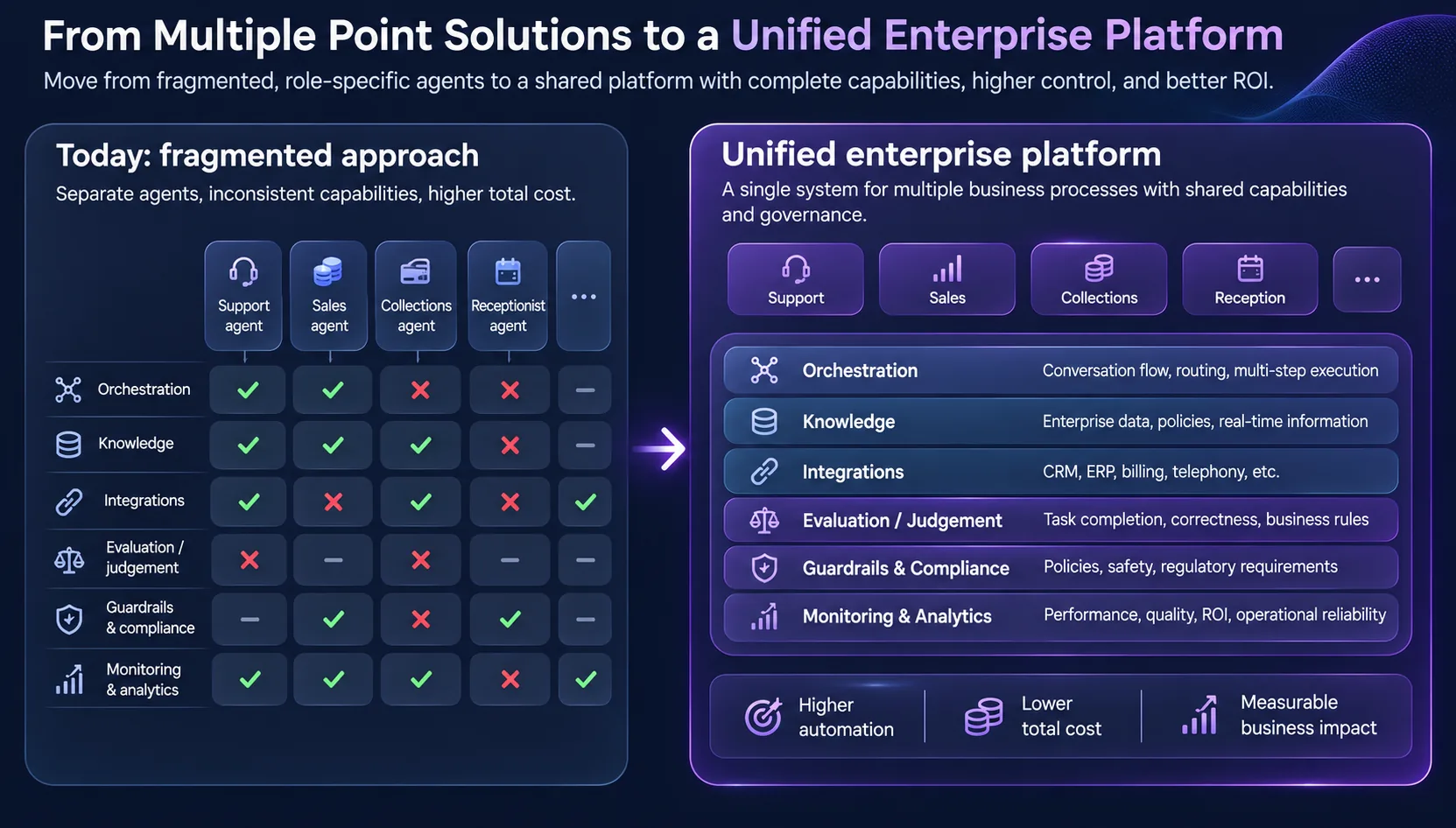
Many initial voice AI deployments are built around individual use cases: a receptionist, an FAQ agent, a lead qualification bot, or an outbound campaign. Each may have its own vendor, infrastructure, integrations, and operating logic.
This makes sense during experimentation. It becomes increasingly inefficient at scale.
An enterprise running ten different voice agents should not need ten separate systems for managing knowledge, authentication, business rules, monitoring, compliance, and integrations. Nor should it have to evaluate and maintain a different technology stack every time another department introduces automation.
I expect the market to move toward unified platforms supporting multiple roles and business processes, with common infrastructure, governance, and operational controls.
This doesn't mean every agent will behave identically or use the same models. A collections agent and an inbound sales agent have different objectives, regulatory constraints, and reasoning requirements. They should be able to share infrastructure while retaining their own domain logic and configurations.
This is precisely the approach we're taking with AgentUnicorn.AI. Rather than developing a separate product for each voice AI use case, we're building a common platform that can support customer service, sales, collections, reception, and other enterprise functions, with shared orchestration, knowledge management, integrations, and guardrails.
The commercial implications are substantial. Expansion from one successful use case to another should require configuring and integrating a new business process, not deploying an entirely new technology stack.
I expect this to become an important enterprise purchasing criterion by 2028. The opportunity is not limited to acquiring new customers; it includes progressively automating more of the existing customer's operations.
Second: the industry will converge toward end-to-end solutions, but not necessarily closed technology stacks
Deepgram's acquisition is a clear example of providers expanding beyond their original position in the value chain.
I expect this trend to continue. Speech providers will add orchestration and hosting, agent platforms will integrate more of the inference and execution stack, and application vendors will develop deeper proprietary capabilities around their customers' workflows.
The reason is straightforward: most enterprise customers don't want to assemble, integrate, and maintain a dozen independent technologies to automate a business process. They want a working system with predictable performance and a clear party responsible for the outcome.
However, I think it's important to distinguish an end-to-end product from a vertically integrated technology stack.
A company doesn't necessarily need to develop its own ASR, TTS, language models, and telephony infrastructure to deliver a complete voice AI solution. It needs to control how those components work together, how the system executes business operations, and how its performance is managed.
This distinction is fundamental to AgentUnicorn.AI's architecture. We're building the orchestration, execution, knowledge, integration, evaluation and control capabilities required for end-to-end automation while maintaining the flexibility to select and replace underlying models and infrastructure case-by-case.
That flexibility is particularly relevant for enterprise customers. The optimal model combination may differ by language, role/workflow, workload, latency constraints and its impact on business-metrics (like 2 second latency ruins sales call, but bearable for several turns in support), cost and resulting ROI. Regulated organizations may require private-cloud or on-premises deployment, while others prefer managed infrastructure.
A closed platform can simplify deployment, but it can also constrain optimization and introduce vendor dependencies. Our objective is to offer the convenience and accountability of an integrated product without forcing customers into a single model provider or deployment environment.
I expect that combination—end-to-end delivery with architectural flexibility—to become increasingly valuable as enterprises move from experimentation to large-scale deployment.
Third: competition will move from conversational performance to measurable business outcomes
As underlying speech technology improves and becomes more accessible, the ability to build a convincing voice agent will become less differentiating.
We already see impressive demonstrations from a growing number of providers. But there is a substantial difference between an agent that conducts a natural chit-chat conversation and one that reliably completes a business process.
I expect enterprise evaluations to become considerably more demanding.
For customer support, the relevant metric will increasingly be the cost of successfully resolving a request, including escalations and repeat contacts. For sales, it will be conversion and incremental revenue. For collections, actual recovered payments. For appointment-based businesses, completed bookings and attendance.
This is more than a change in reporting. It changes what companies need to optimize.
A system with higher inference costs may deliver better economics if it resolves more requests without escalation. Additional validation and reasoning may increase latency but reduce transaction errors. A slightly less natural conversation may still perform better commercially if it executes the underlying workflow more reliably.
We approach AgentUnicorn.AI from this perspective: speech quality, latency, reasoning, and orchestration are engineering objectives, but the ultimate goal is measurable improvement in the customer's business performance.
That also determines where we invest in the platform. Knowledge grounding, business-system integrations, execution controls, guardrails, and operational monitoring are not secondary features. They are necessary to make autonomous agents reliable enough to handle valuable business processes.
Our aim is to evaluate deployments against agreed business KPIs and demonstrate their economic impact, rather than rely on conversational demos or isolated model benchmarks.
By 2028, I expect verified task completion, business impact, and total cost of automation to become more important in enterprise procurement. Vendors that cannot demonstrate these results will face increasing pressure, regardless of how impressive their underlying models are. Also, that make significantly shift the pricing of the AI solutions – from paid minutes to achieved business results or success-fee/share of margin.
The broader direction: infrastructure consolidation can accelerate market expansion
It's tempting to interpret acquisitions like Deepgram–Daily as a sign that voice AI is consolidating around a few large providers, leaving limited opportunities for independent companies.
I think this misses an important part of the economics.
Infrastructure consolidation and application-market expansion can happen simultaneously. As foundational technologies become cheaper, more capable, and easier to integrate, the number of economically viable applications increases.
We have seen a similar pattern in cloud computing. A relatively concentrated infrastructure market enabled an enormous ecosystem of specialized software companies. Those companies didn't need to operate their own data centers to build substantial businesses.
Voice AI has its own dynamics, particularly because infrastructure vendors can move directly into vertical applications, as Deepgram has already demonstrated with OfOne. That creates real competitive pressure for providers offering basic, easily replicated agents.
But enterprise automation is a much broader problem than providing voice infrastructure.
A bank, insurer, telecom operator, or retailer needs systems that understand its processes, integrate with existing infrastructure, enforce business rules, handle exceptions, and deliver measurable operational improvements.
These requirements won't disappear because speech recognition becomes cheaper or orchestration becomes a managed service.
In fact, I expect improved infrastructure to accelerate the adoption of end-to-end automation by reducing development costs and making more complex use cases commercially attractive.
For AgentUnicorn.AI, this is the market opportunity we're building toward: a growing enterprise automation market in which basic voice technology becomes increasingly accessible, while integration, reliability, deployment flexibility, and business-process expertise determine who can deliver the best results.
The next phase of competition will not be about who can make an AI agent speak. It will be about who can make it do useful work, at scale, with economics that justify replacing or augmenting existing processes.