
Jev-like Decision Models Make Prototyping Trivial. Production Still Requires ML Engineering
A reusable decision model can remove task-specific training from the critical path. It cannot remove task specification, representative evidence, calibration, selective automation, replay, monitoring, or change control. What actually changes in the ML lifecycle — and what does not.
Contents
A reusable decision model can remove task-specific training from the critical path. It cannot remove task specification, representative evidence, calibration, selective automation, replay, monitoring, or change control.
In my previous article on Jev and the open-source decision-model ecosystem, I focused on the model layer: what TypeSafe disclosed, what can be reconstructed from behavior, how the open-source projects approximate the same computational problem, and why bounded semantic decisioning is becoming a useful inference primitive of its own.
The product proposition is attractive for a good reason. Give the model state, formulate a bounded question, receive probabilities or scores, map them to an action. For many tasks this removes a surprising amount of machinery from the first implementation: no task-specific classifier training, no separate serving stack, no fine-tuning cycle, and no reason to spend frontier-model latency generating JSON for a decision with three valid outcomes.
For a prototype, that may be the whole integration.
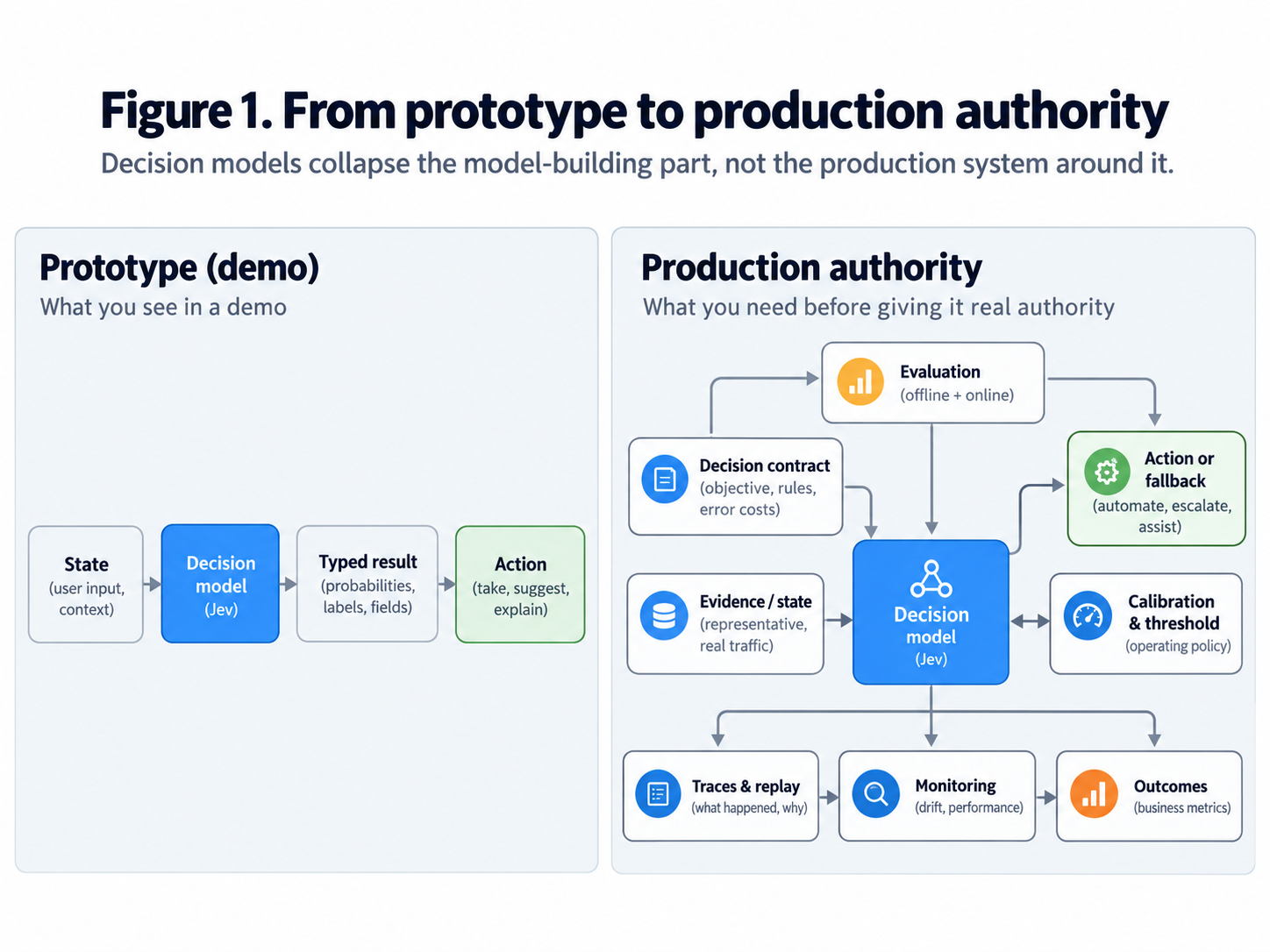
Production starts when the output receives authority over a business process. At that point model quality is only one variable in a larger system. The observed error rate depends on the decision definition, state construction, option set, language and channel mix, upstream retrieval or ASR, threshold policy, fallback path, and the traffic distribution on which the threshold actually runs.
A vendor can therefore be completely correct that a model requires no customer-specific training and still be far from demonstrating that a customer's decision is production-ready.
The distinction I use is:
Decision models may remove per-decision model training. They do not remove per-decision validation.
The work moves rather than disappears. Instead of training another narrow model, the team defines the decision with the process owner, constructs the evidence, builds a representative eval set, measures error at the intended operating point, decides which cases can be automated, specifies fallback, traces decisions, and re-runs the evidence when the pipeline or traffic changes.
That is the part of the Jev thesis I find most interesting. If model construction becomes cheap enough, hundreds of small semantic decisions that were previously uneconomic become candidates for automation. But the same low friction makes it easy to reach a convincing demo before the system has accumulated any of the evidence normally required to trust it.
TL;DR
The MVP can genuinely look like this:
state
→ decision-model call
→ typed result
→ workflow action
The production object is closer to:
business definition
→ decision contract
→ state / evidence construction
→ representative eval data
→ response-type and option tests
→ calibration
→ risk / coverage
→ threshold + fallback
→ shadow
→ trace + replay
→ monitoring
→ outcome collection
→ re-evaluation
“95% accurate,” “calibrated,” and “no training required” are model-level claims. Production authority needs evidence for the deployed workflow: its traffic distribution, error costs, empirical error at the automation threshold, fallback rate, important slices, upstream dependencies, and the ability to reconstruct a consequential decision later.
The rest of the article is about that evidence layer.
1. The demo is cheap; authority is not
Consider a support or Voice AI agent with five bounded decisions:
Should the agent escalate to a human?

Which tool or workflow should handle this request?

Is this action allowed by policy?

Is the retrieved evidence sufficient to answer?

Should the agent continue, ask for clarification, or fall back to a stronger model?
With a Jev-like model, each branch can be close to:
state
→ bounded question
→ probabilities
→ action
The fixed cost is low enough that an engineer can add several decisions in a day and get a convincing demo without another training pipeline. A narrow classifier would usually need examples, labeling, training, packaging and serving; a frontier LLM avoids training but pays for general-purpose generation, schema enforcement and higher latency. A reusable decision model attacks that middle layer.
Jev makes ‘ship first, validate later’ dangerously tempting.
The demo proves that the integration works and produces plausible outputs on sampled cases. It does not establish whether 0.94 maps to a 6% or 1% live error rate, whether that mapping survives Spanish voice, whether the correct option is present, whether irrelevant state degrades the decision, or whether a false negative costs $2 or creates a compliance incident.
The integration can be generic. The operating evidence cannot.
2. What “production-ready” has to prove
The production claim has to identify the exact decision. “Support routing” is not enough; “escalate on explicit supervisor request, regulatory complaint, or a validated score above threshold” is closer. Error costs and exceptions come from the process, so the decision needs an accountable owner.
The evidence must match deployed traffic. A clean English benchmark says little about Spanish chat, English PSTN audio, Arabic voice, long RAG context or tenant-specific policy data. The weights can stay fixed while the statistical problem changes.
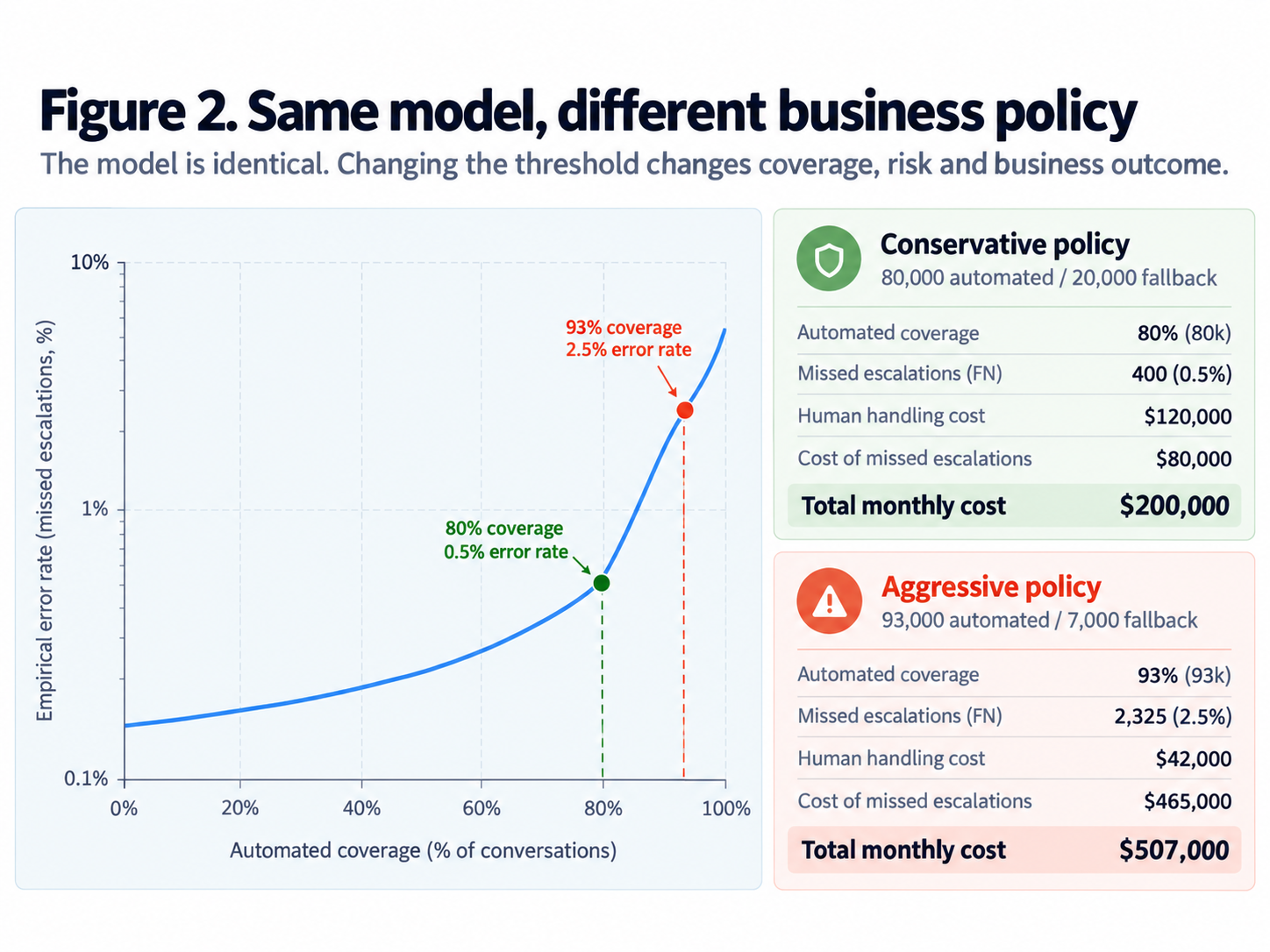
The operating point matters more than headline accuracy. If automation runs only for p >= 0.95, the relevant evidence is the empirical error among cases above 0.95; 10,000 total examples may still be weak support if only 37 reach that region.
Fallback is part of the policy. Low-confidence or structurally invalid cases may route to a rule, stronger model, clarification, second retrieval pass, human review or abstention. Coverage and fallback determine both risk and economics.
Suppose a support team receives 100,000 conversations a month. At one threshold the decision layer automates 80,000 and sends 20,000 to the existing human path; at a lower threshold it automates 93,000 but produces materially more missed escalations. The model has not changed. The business policy has. The relevant decision is whether the incremental 13,000 automated cases are worth the additional error cost, not whether the underlying model still scores well on a benchmark.
Consequential actions also need reconstructable traces: model and state-builder versions, formulation, candidate set, raw scores, threshold policy, fallback and selected action. Prior evidence also has an expiry condition: changes in retrieval, ASR, state filtering, options, traffic mix or business policy can invalidate a tuned threshold without changing model weights.
For an enterprise rollout I would also make the acceptance criteria workflow-specific. “Jev is calibrated” is not an acceptance test. “On the agreed September traffic mix, escalation false negatives stay below 2% at at least 75% automated coverage, with the remainder routed to the existing queue” is. That is a statement a process owner, ML team and vendor can all test against the same evidence.
Those requirements are generic. They apply to Jev, a narrow classifier, an LLM judge, a learned router, a fraud model or a proprietary decision service. The implementation differs; the production obligations do not.
3. The ML lifecycle changes
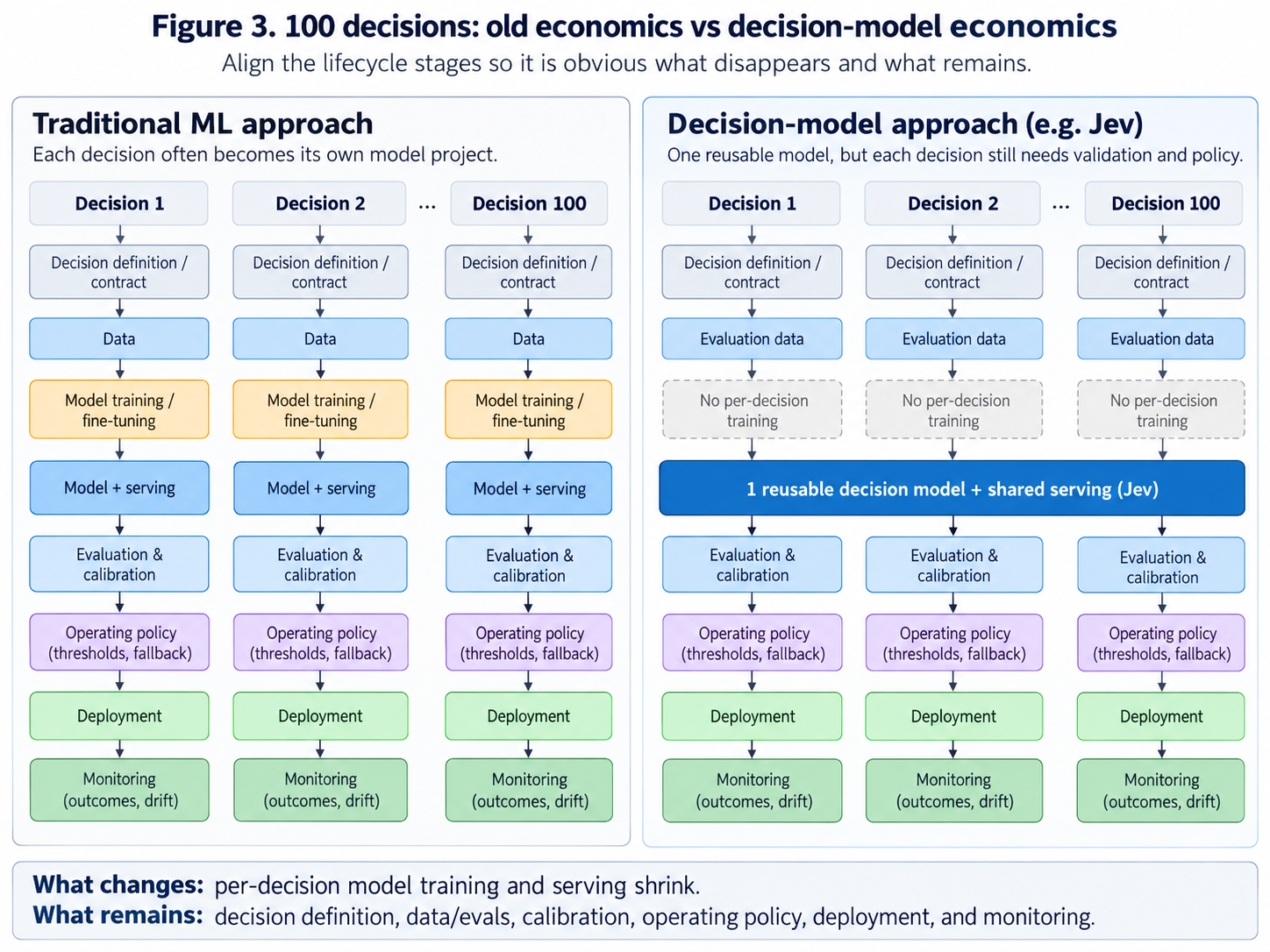
A conventional narrow classifier often follows:
define task with process owner
→ collect data
→ make labels
→ split data for evaluation
→ train
→ evaluate
→ calibrate
→ deploy
→ monitor
→ retrain
A reusable decision model changes the front half:
define task with process owner
→ define decision contract
→ build evaluation data
→ validate transfer
→ calibrate operating policy
→ deploy
→ monitor
→ re-evaluate
The removed work is mostly model construction and per-task serving.
If an organization has 100 small semantic decisions, the conventional path can turn them into 100 separate model projects. Some justify the cost; many do not. The long tail remains in brittle rules, expensive generic LLM calls, manual review, or the backlog.
TypeSafe currently states that Jev uses the same weights across accounts: no per-customer fine-tune or LoRA is required, while state, instructions, criteria and decomposition shape the task.
If transfer is strong enough, the operating model moves from roughly:
100 decisions
≈ 100 model projects
toward:
100 decisions
≈ 1 reusable model
+ 100 decision contracts
+ 100 evals
+ 100 operating policies
That can remove a large amount of model engineering. It does not collapse the 100 business decisions into one statistical problem. Each still has its own class balance, ambiguity, error costs, operating threshold and production distribution.
The older production-ML literature therefore becomes directly relevant. Sculley et al.'s Hidden Technical Debt in Machine Learning Systems described data dependencies, feedback loops, configuration debt and changing external environments. Breck et al.'s The ML Test Score turned similar experience into tests around data, model behavior, integration, monitoring and recovery. Jev changes the cost of obtaining the model; it does not remove those system-level failure modes.
4. The decision contract should be a versioned artifact
Natural-language task definition makes new decisions cheap to formulate. It also makes it easy to automate a question before the organization has agreed on what the question means.
For any decision with meaningful authority, I would create a versioned contract between the process owner and the technical system:
decision_id: support.escalate.v3
owner: customer_support_operations

objective:
  decide_when_to_handoff_to_human

authoritative_inputs:
  - conversation_state
  - customer_tier
  - open_complaints

state_builder: support_state_v12
question_version: escalation_v5

primitive: choice
options:
  - continue_ai
  - escalate_human

model: jev-1.13.0

error_budget:
  false_negative_max: 0.02

thresholds:
  escalate_human: 0.91

fallback:
  low_confidence: frontier_llm
  policy_conflict: human

calibration_dataset: escalation-prod-2026-09
stress_suite: escalation-edge-v4

monitoring_slices:
  - language
  - issue_type
  - customer_tier
  - asr_vs_text
The exact schema matters less than ownership and versioning. Once a model output controls the branch, this object is business logic.
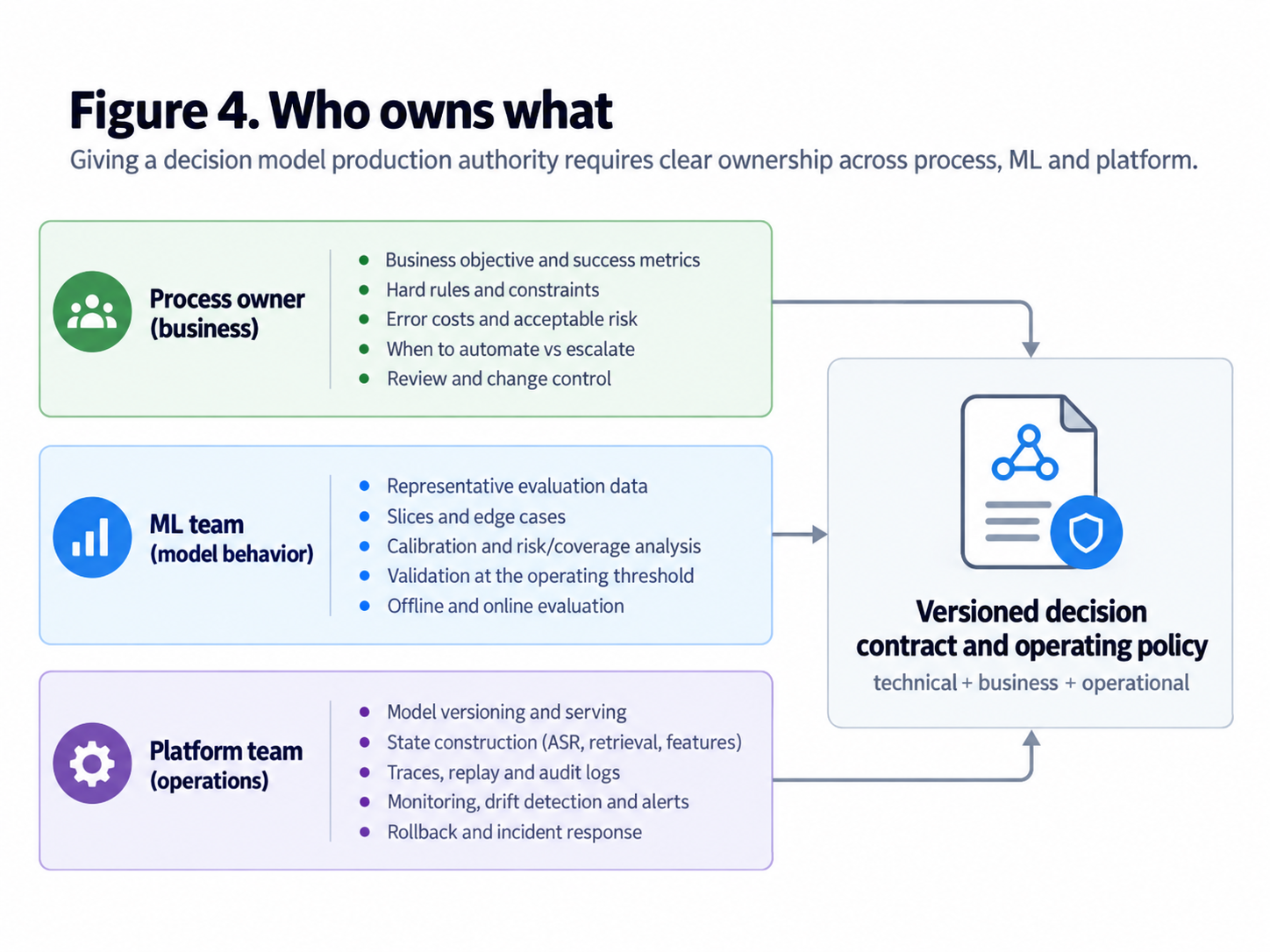
The ownership split is also useful organizationally. The process owner defines the objective, hard exceptions and error costs. The ML team demonstrates behavior on representative data and chooses an operating region that satisfies those constraints. The platform team makes the policy versioned, observable, replayable and reversible. Collapsing those responsibilities into “the model decides” is how a technical component acquires business authority without anyone explicitly owning the policy.
Several fields cannot be inferred from model behavior. Does an explicit supervisor request force escalation? Does a regulatory complaint always escalate? Can queue pressure influence the decision? Is a false positive an extra $4 support interaction while a false negative can create a legal escalation? Better calibration cannot resolve disagreement about those questions.
The same pattern appears in tool routing, eligibility, policy enforcement and retrieval. Tool routing needs a defined option taxonomy and a meaning for none. Eligibility needs authoritative evidence and exception precedence. Retrieval relevance needs a downstream definition of sufficient evidence, not merely semantic similarity.
A decision model can generalize across tasks. The task contract cannot be generic.
5. The deployed pipeline defines the task
Two formulations that look equivalent to a developer do not necessarily produce interchangeable scores.
TypeSafe documents this in its Jev 1.13 jaggedness notes. For the ticket:
“I’m not happy with the fit. What are my options here?”
asking:
“Is the customer asking for a refund?”
as a Noul returns 0.22. The apparently equivalent binary Choice returns:
yes = 0.01
no  = 0.99
confidence = 0.97
TypeSafe explicitly warns against carrying a threshold tuned for a Noul over to a Choice. Both outputs are probabilities: a Noul returns the probability that its proposition is true, while a Choice returns a normalized probability distribution over the supplied alternatives. But the calibration does not necessarily transfer between the two formulations. In TypeSafe's example, the same refund question returns 0.22 as a Noul but only 0.01 for yes when formulated as a binary Choice.
The same limitation appears across separately formulated Nouls. TypeSafe shows a refund proposition and its apparent complement returning:
refund      = 0.72
not_refund  = 0.47
sum         = 1.19
This does not make the Noul values non-probabilistic. It shows that Jev does not guarantee algebraic consistency across separately posed natural-language questions: P(X) should not be assumed to equal 1 - P(not X). If the production logic requires that invariant, compute the complement in code rather than asking the model twice.
For production, the response primitive, wording and candidate set therefore belong in the versioned decision definition. If the workflow needs an invariant, enforce it in code. If a threshold was calibrated on one formulation, changing the formulation is a policy change even when the English looks equivalent.
The same logic applies upstream. TypeSafe says English is Jev's primary training language and currently its strongest. A Voice AI deployment inserts ASR, normalization and state construction before the decision call, so clean English text says little about Spanish or Arabic voice, code-switching, noisy telephony or systematic ASR substitutions.
State construction can move quality without any model change. TypeSafe's Jev 1.13 documentation reports degradation as irrelevant context grows. Moving a RAG pipeline from top-3 reranked chunks to top-10 raw chunks keeps the model version fixed while changing the evidence distribution and distraction load.
Candidate construction is equally material. Is the correct outcome present? Are options mutually exclusive? Is there a none, unknown or needs_review state? Does cardinality change? Archestra's real-agent evaluation found small but measurable option-order sensitivity on three-way choices, enough to justify including candidate construction in regression.
TypeSafe also separates returned option probabilities from its derived confidence field. Confidence measures concentration in the returned distribution; it is not an empirical probability of correctness. The application maps model output to a business action through a threshold and fallback policy.
The unit that needs evaluation is therefore:
upstream pipeline
→ state construction
→ question / primitive / options
→ model
→ threshold policy
→ fallback
→ business action
A model benchmark describes one component of that chain.
6. The eval harness becomes a shared platform asset
If one decision model serves dozens or hundreds of workflows, a common eval and replay layer becomes more valuable than any single decision configuration.
Each production decision still needs a dataset representative of the workflow, with enough metadata to diagnose failures by slice. For agent workloads I would deliberately include cases that expose boundary conditions rather than sampling only happy-path traffic.
Escalation data should contain routine requests, anger, explicit supervisor requests, regulatory complaints, ambiguity and customer segments with different treatment. Tool routing should contain obvious tools, overlapping tools, missing arguments, unsupported requests and no tool. Policy checks should include exceptions, conflicting evidence, missing evidence and adversarial framing. Retrieval relevance should include relevant passages, near misses, partial evidence, stale documents, conflicts and cases where the retriever failed to return the answer at all.
The record should carry more than input → label:
state
question + version
response primitive + options
expected outcome
language / channel
business cost of error
ambiguity flag
customer/process slice
upstream pipeline version
That metadata turns “accuracy fell by 3 points” into an operational diagnosis: Arabic voice degraded after an ASR change, one tenant's state length doubled, candidate cardinality increased, or the high-risk class has only 27 examples above the automation threshold.
Regression should run across the entire decision contract. Model version, state builder, retriever/reranker, wording, response primitive, candidate descriptions, calibration method, threshold and fallback can all change the effective policy.
If p > 0.95 executes a real action, a model alias moving to a new release is not a transparent infrastructure upgrade. TypeSafe's model-version documentation makes the same operational point: pin versions when thresholds depend on them and migrate deliberately.
7. Calibration has to match the operating distribution
For production, the useful calibration question is whether the score used by a specific workflow maps to empirical error on the traffic where the threshold executes.
Suppose production traffic is:
70% English chat
15% Spanish chat
10% English voice
5% Arabic voice
and the calibration set is 500 clean English examples written by the engineering team. The threshold can be estimated precisely and still be wrong for production.
Representative calibration data should cover variables that materially affect the task: language, channel, customer segment, state length and source, retrieval behavior, candidate cardinality, ASR characteristics, seasonality and upstream versions.
High-risk workflows usually need two datasets:
calibration / operating set
≈ production distribution
and:
stress / regression set
≈ enriched with rare, expensive,
  ambiguous and adversarial cases
The first estimates live behavior. The second prevents a 0.1% but catastrophic class from disappearing in a frequency-matched sample.
Sample size belongs to the operating point
If the policy is:
act automatically when p >= 0.95
the relevant n is the number of evaluation examples above 0.95, not the size of the full benchmark.
If 5,000 examples produce only 40 automated cases and none fails, the evidence is still weak. Using the standard rule-of-three approximation for zero observed failures, the upper 95% error bound is roughly 3/n: about 5% after 60 cases, 1% after 300 and 0.1% after 3,000.
The support size and interval should therefore be reported at every operating point used to justify production authority. A threshold without support size is incomplete evidence.
Upstream changes can invalidate calibration
ASR, retrieval, chunking, reranking, state filtering, wording, options, model version and customer mix all sit upstream of the action policy. Any of them can change the mapping from model score to empirical error.
Guo et al.'s calibration paper is useful background on why accurate neural networks can still be poorly calibrated. TypeSafe's confidence documentation likewise recommends choosing thresholds for the use case and evaluating them on the user's own data.
The defensible production claim is deliberately narrow:
On this versioned pipeline, on this traffic distribution, the measured error at this operating point is within the agreed error budget.
8. Risk/coverage is usually more useful than aggregate accuracy
Aggregate accuracy can be actively misleading for decision systems.
If 95% of support requests should continue and 5% should escalate, a constant continue policy scores 95% accuracy while detecting zero escalation cases.
Archestra's 100-call evaluation had a similar structure: 79% of tool-call decisions belonged to the benign/default class, so a constant baseline already scored 79%. Their error costs were asymmetric as well: one direction could stall the agent; the other could allow data to leave the system.
The operating question is:
At the maximum error rate the process can tolerate, what fraction of traffic can we automate?
That is the risk/coverage problem from selective classification. Geifman and El-Yaniv's Selective Classification for Deep Neural Networks formalized the reject-option view: abstain on uncertain cases to reduce risk.
Operationally:
lower threshold
→ more automated traffic
→ usually more empirical error
higher threshold
→ less automated traffic
→ more fallback
→ usually less empirical error
The dashboard should include per-class precision/recall, false-positive and false-negative cost, coverage, fallback rate, empirical risk at each threshold, support size at each threshold, and fallback latency/cost. ECE and Brier score are useful diagnostics, but the business operates a thresholded policy, not a calibration chart.
This also prevents a common architecture mistake: using one confidence policy for every decision because the underlying model API is the same. A wrong support-screen route, an unnecessary human handoff, a loan-related rejection and authorization of a money movement have completely different error budgets.
Risk/coverage also gives a cleaner business model for automation. The useful question is often not whether the model can replace 100% of the process, but whether it can handle the clear 60%, 80% or 95% at an acceptable measured risk while the remainder takes a slower or more expensive path.
The economics can be written almost as a unit-cost equation. If human handling costs $6, the decision path costs $0.02, and 20% of traffic still falls back to a human, then 80% coverage can already remove roughly $4.78 of handling cost per request before error cost and fixed platform cost. Moving from 80% to 90% coverage saves another ~$0.60 per request, but only if the extra automated band remains inside the process error budget. Once error cost becomes asymmetric — a missed compliance escalation can cost orders of magnitude more than an unnecessary handoff — maximizing coverage stops being the objective.
Those numbers are illustrative, but the structure is general: expected automation savings minus fallback cost minus expected error cost minus platform cost. A threshold is therefore an economic and risk-control parameter, not only an ML hyperparameter.
9. Ground truth is sometimes harder than the model
A significant amount of “model error” is unresolved process semantics.
Archestra started its agent-security benchmark with 100 tool calls and four labels per call, or 400 decisions. Three independent model families judged the expected answers blind; their published analysis reports the 337 decisions where all three agreed. The remaining 63 of 400 exposed unresolved semantics around outbound search, opaque IDs and whether particular tool metadata should be treated as internal or public.
In production, disagreement can come from:
model error
annotation error
business/process specification error
Those categories should not be collapsed. If reviewers disagree because policy is unclear, forcing a binary label creates false certainty. Explicit states such as ambiguous, insufficient_evidence, policy_conflict or requires_business_adjudication preserve the specification problem until the owner resolves it. In a high-risk workflow, one of those states may also be the correct runtime outcome and should route to additional evidence, a stronger model or human review.
The benchmark should therefore report label quality and adjudication rate. A model scoring 95% on the 80% of cases where reviewers agree describes a different production situation from 95% accuracy on a fully specified task.
No model architecture repairs an undefined policy.
10. Some “classification” decisions are interventions
A second evaluation error comes from treating every bounded output as a passive label.
“Is this retrieved passage relevant?” is mainly predictive: the passage exists and reviewers can judge its relevance after the fact.
“Should we escalate this customer?” can be an intervention:
state
→ choose action
→ action changes the future trajectory
If the system escalates, we never observe what would have happened had the AI continued. If it continues, we do not observe the counterfactual outcome under escalation.
The same issue appears in retention offers, collections strategy, next-best action, recovery flows and many agent policies. An offline label such as should_escalate = true can encode expert policy, but it does not prove that escalation improves the downstream business outcome.
Those cases eventually need experimental or policy-evaluation machinery: controlled A/B tests where safe, champion/challenger rollout, bounded exploration, or off-policy evaluation when historical propensities are available. Wang, Agarwal and Dudík's work on off-policy evaluation is one reference point for estimating a target policy from data generated by another policy.
A decision API makes prediction and policy selection look syntactically similar. Statistically they are different problems and should not share an evaluation recipe by default.
11. Node accuracy does not tell you agent reliability
Agents compose multiple decisions, and early errors change the state seen by later decisions.
A simplified flow might be:
retrieval relevant?
→ answer or retrieve again
→ tool needed?
→ choose tool
→ action permitted?
→ execute
→ escalate?
If the retriever returns the wrong evidence and the relevance gate accepts it, every later decision operates on a trajectory that would not exist under the reference policy. A wrong tool changes the next state and available evidence. A language or ASR problem can corrupt several decisions in the same call.
Even under the unrealistic assumption of independent errors, twenty decisions that are each 97% accurate do not create a 97%-reliable trajectory. In practice the errors are correlated, so multiplying node metrics is not a useful system estimate either.
I would maintain two evaluation layers:
node-level
→ does each bounded decision satisfy its contract?
trajectory-level
→ does the complete agent achieve the intended outcome
  across realistic sequences of states and failures?
Trajectory evaluation should use scenario suites, replayed production traces and deterministic business assertions wherever possible. LLM judges are useful, but they should not be the only oracle for checks that can be expressed as code.
This layer also exposes latency economics. A node with excellent standalone accuracy but a 40% fallback rate into a two-second model may be a poor component in a sub-second voice path.
12. Trace, replay and drift form one control loop
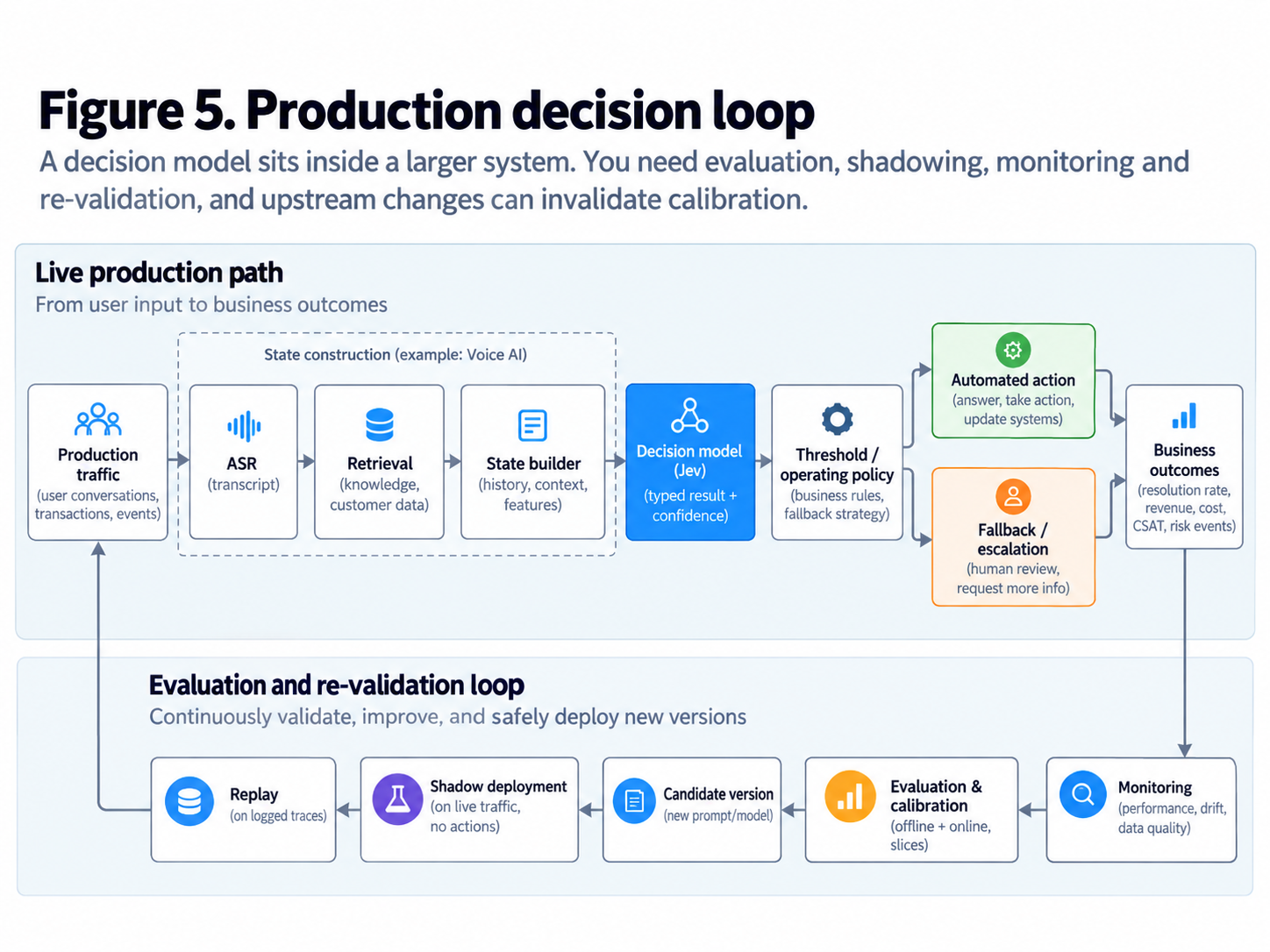
For any consequential decision, the trace should contain enough information to reconstruct the action:
timestamp / decision ID
model + exact version
state-builder version
question / criteria version
response primitive
candidate set
raw probabilities
returned confidence, if any
calibration / threshold-policy version
selected action
fallback path
latency
language and important slices
eventual business outcome, when available
RAG and voice paths usually need retrieval references, retriever/reranker version, ASR version and tenant/customer segmentation as well.
Suppose escalation failures rise after a Tuesday release. Possible causes include the decision model, retriever, state filter, wording, candidate descriptions, ASR, traffic mix, threshold, policy, or an actual change in customer behavior. The final action label cannot distinguish them.
Replay closes the loop:
production traces
→ candidate model/configuration
→ offline replay
→ compare actions, scores and slices
→ live shadow
→ controlled rollout
A horizontal model may sit behind dozens of branches, so its influence radius can exceed that of a narrow classifier. Replaying historical production traffic before a version or policy change is correspondingly more valuable.
Monitoring should cover the distributions that define the effective task, not only classical feature drift: action frequency, option cardinality, state length, source mix, language mix, ASR-vs-text share, score distribution, entropy, fallback rate, automated coverage, latency, and delayed error by score bucket once labels arrive.
Some signals are useful before labels arrive. If a retrieval release doubles average entropy, or escalation jumps from 3% to 14%, the model is already seeing a different problem even if the cause is not yet known. I separate four categories:
input drift
language, state length, customer mix, ASR quality
decision-distribution drift
class frequencies, option sets, candidate cardinality
calibration drift
score no longer maps to the same empirical error
policy drift
the business definition of the correct action changed
The fourth case is common in enterprise workflows and cannot be fixed by retraining against yesterday's labels. Process ownership therefore belongs in the monitoring loop, not only in initial requirements.
13. Shadow first, then expand authority
The rollout path should match the cost of error.
Low-risk routing can move quickly; permissions, money, compliance, customer access or safety should receive staged authority:
offline evaluation
→ live shadow
→ canary/ friends and family release
→ advisory
→ automate low-risk / high-confidence cases
→ expand coverage
Shadow mode gives the model real traffic, real state lengths, real option sets and real latency while keeping the incumbent process authoritative. It also produces the first useful live score distribution and exposes disagreements before automation affects customers.
Fallback belongs in the design from the start. Depending on the task it may be a deterministic rule, stronger LLM, second decision model, another retrieval pass, clarification, human review or explicit abstention.
In many systems the economically attractive architecture is a cascade: a cheap decision model handles the clear majority, while uncertain or expensive cases consume more compute or human attention. Calibration matters because it allocates resources and risk.
The infrastructure can stay compact: versioned dataset, reproducible eval runner, slice metrics, risk/coverage analysis, traces, replay, shadow comparison and a review queue. The controls should scale with authority, but production behavior must remain measurable, versioned and recoverable. This is close to the old ML Test Score framing: readiness is distributed across data, model behavior, integration, monitoring and recovery.
14. What Jev actually removes
After all of the production machinery, the economic case remains strong.
A reusable decision model can reduce or remove:
per-task model architecture work
per-task training jobs
per-task serving
per-task fine-tuning
retraining after every taxonomy change
data generation required merely to get v1 working
The marginal project can move toward:
define decision
→ collect / build eval data
→ validate formulation
→ measure operating points
→ define threshold + fallback
→ deploy
→ monitor
The immediate comparison is a frontier LLM used as an expensive classifier but remember that it has its own errors and also need same validation cycle. The larger opportunity is the long tail of business decisions that were never worth automating before: when to escalate a customer, approve an exception, route a case, qualify a lead, request additional information, trigger a retention offer, assign specialist handling, or let the process continue automatically. If a reusable model makes those decisions cheap enough to implement, the addressable automation space grows even when each branch is small.
For a company, that changes the portfolio math. A decision saving $50,000 a year may never justify a dedicated classifier with its own data pipeline, serving and maintenance. If the model and evaluation infrastructure are shared, the incremental implementation can become small enough that dozens of such decisions clear the ROI threshold. The platform value then comes less from one spectacular use case and more from lowering the fixed cost of automating the next 50 postponed decisions.
That, more than leaderboard differences between Jev releases, is why I think the category matters.
15. A practical due-diligence test
For any product claiming that a general decision model is production-ready, I would want concrete answers to a short set of questions.
Before giving the model production authority, I would require evidence for the actual business decision it will control. On representative traffic, how much can it automate at the error rate the process can tolerate? Which mistakes are expensive? What happens to uncertain cases? Does performance hold across the important languages, channels and customer segments? And if ASR, retrieval, state construction, the option set or the model itself changes, which parts of that evidence need to be rebuilt?
Those answers can then become the launch criteria: maximum tolerated error for consequential classes, minimum automated coverage, required fallback behavior, required slices, and the exact pipeline version against which the numbers were measured. A generic benchmark should never quietly become the acceptance test for a different production workflow.
Claims such as “same weights for every customer,” “no training required,” or “calibrated probabilities” explain why the model is easy to adopt. They do not tell you whether it is safe or economical to automate your decision. That requires evidence from your process, your traffic and the operating point at which you intend to give the model authority.
16. Conclusion
Jev changes the economics of bounded semantic decisions because it can remove task-specific training and serving from the first implementation. That makes many branches cheap enough to prototype and, potentially, cheap enough to operate.
The production workload moves elsewhere: decision specification, representative data, response semantics, calibration, risk/coverage, error budgets, fallback, traceability, replay, drift, trajectory evaluation and policy change.
For mature ML teams, none of those disciplines are new. What changes is the ratio between the cost of obtaining the model and the cost of validating the business decision. When the model call becomes trivial, the validation layer becomes a larger share of both the engineering work and the production risk.
I would therefore evaluate Jev and similar systems on two axes. First: how much model engineering or expensive LLM cost do they remove? Second: how cheaply can the organization build enough evidence and control around each decision to give it real authority?
If both answers are good, the category is important. One reusable model can support a long tail of semantic decisions that previously remained rule-based, manual, implemented through expensive general LLMs, or ignored because another classifier project was not worth the fixed cost.
If only the first answer is good, you get excellent demos.
If you are preparing such a system for production, talk to us before you decide that the demo is done.
Explore what decision models could change in your AI architecture.
FAQ
Does Jev remove the need to train a classifier for every workflow?
Potentially, it can remove for many. TypeSafe says Jev uses the same weights across accounts and adapts through the request rather than customer-specific fine-tuning. The workflow still needs its own decision definition, evaluation and operating policy. And business-critical high-volume paths can benefit from a specialized trained classifier giving better accuracy than Jev.
Do I need labeled data?
Not necessarily, including for production. What production requires is evidence that the decision behaves acceptably on representative traffic. That evidence can come from sampled human adjudication, shadow-mode decisions, existing business outcomes, or targeted evaluation around the operating threshold. You may need hundreds or thousands of reviewed examples to support a low error rate, but you do not necessarily need to build and maintain a task-specific training dataset.
How large should the evaluation set be?
There is no universal number. What matters is prevalence, important slices, the target error budget and how many examples reach the automation region; a 10,000-example benchmark can still provide weak evidence for a 0.99 threshold.
Is TypeSafe's confidence the probability that Jev is correct?
No. TypeSafe defines it from the shape of the Choice or Score probability distribution; Nouls mean it as "yes" probability. And slightly changing the question changes its probabilities. Any score used for production authority should be mapped empirically to error on the deployed workflow.
Can I use one threshold across languages and customers?
I would assume no until measured. Language, ASR vs text, domain, customer segment, state construction and option set are obvious variants to evaluate accuracy by given threshold.
What production metric matters most?
For many bounded decisions I would start with risk/coverage: at the accepted empirical error rate, how much traffic can be automated, how much falls back, and what does that fallback cost in latency and money?
Sources and further reading
- Jev Architecture Explained: Open-Source Clones, Benchmarks, Calibration, and Production Trade-Offs — the architecture-focused first article in this series.
- TypeSafe — Models — model/version information, language support, same-weights customization model and version-pinning guidance.
- TypeSafe — Confidence — distinction between returned probabilities and TypeSafe's derived confidence statistic, plus thresholding guidance.
- TypeSafe — Jev 1.13 jaggedness — first-party failure modes including irrelevant context, arithmetic/date limitations, adversarial content and structural non-invariance.
- Archestra — We Tested Jev on 100 Real Agent Calls — real-agent evaluation with class imbalance, asymmetric error costs, judge disagreement, option-order tests and concrete failure analysis.
- Sculley et al. — Hidden Technical Debt in Machine Learning Systems — system-level technical debt, data dependencies, feedback loops and external change in production ML.
- Breck et al. — The ML Test Score — production-readiness tests spanning data, model behavior, integration, monitoring and recovery.
- Guo et al. — On Calibration of Modern Neural Networks — background on neural-network calibration.
- Geifman & El-Yaniv — Selective Classification for Deep Neural Networks — risk/coverage and reject-option framing.
- Wang, Agarwal & Dudík — Optimal and Adaptive Off-policy Evaluation in Contextual Bandits — background for evaluating policies when the chosen action affects the observed outcome.
About the author
I have been building ML/AI systems for around 20 years, including production systems across multiple enterprise domains, and currently build low-latency conversational and Voice AI at AgentUnicorn.AI.
Decision models are interesting to me because they compress the model layer without removing the production problems around it: specification, data, calibration, latency, workflow control, observability, rollout and change management. Those are the parts that make production ML systems materially different from their demos.
If you are evaluating Jev, an LLM judge, a learned router, or any other AI component that will control a real business process, the model benchmark is only the starting point.
At AgentUnicorn.AI, we build production AI systems around exactly these constraints: decision design, evaluation, calibration, guardrails, fallback, observability, latency and controlled rollout.
If you are deciding what an AI system can safely automate—and what evidence should exist before giving it production authority—I am interested in comparing approaches.